
If you are interested in my current research in the areas of community, (hyper)local democracy, connections and knowledge, visit Community-KNect
15 Jun 2017
Comments Off on Keep up with my current research
Talking to imagined citizens: Why share information when no-one talks back?
This is a subject I’ve been thinking about for a long time: the old eparticipation problem of lurkers. I described the challenges of understanding posting to a non-responsive audience in blog posts here and here, back in 2017, when I was getting my thoughts together. (Academic writing and publication is not a fast process.)
One of my very first areas of academic research dealt with the transition from lurking to engagement with epetitioning systems.
This paper takes a different perspective: why (and when) do representatives share information even when they know there will be no response? That is, what is the response by democratic practitioners to the problem of lurkers? It turns out that feeling of duty and acting out their role as a representative are a significant motivation here. (That is, there is no expectation of a payback).
This paper takes an information science approach (specifically information practice), and I co-authored it with Prof Hazel Hall, who was able to turn it into a much clearer piece of writing, as well as adding her own perspectives and deep knowlege of the LIS domain. You can find her write up of the work here.
The theoretical development is to introduce the idea of information sharing by proxy: that is, extending the understanding of how and when people share information to include the idea of the duty to share because no-one else has done so yet.
The article has been accepted for publication by Information Research (they really need to invest in an HTTPS certificate), but author’s copies can already be downloaded from here at Napier document repository.
Posted in e-participation, Information behaviour, UK
Tagged Community Councils, lurkers, scotland, social media
1 Comment
Community representatives, information channels and citizen democratic engagement
Here’s a link to something I co-authored with Hazel Hall and Bruce Ryan: a paper which explores how elected (yet unpaid) community councillors in Scotland exploit information channels for democratic engagement with the citizens that they represent. We demonstrate that community councillors engage with a range of information sources and tools in their work. The most important of which derives from local authorities: Citizens were not seen as a useful source of information.
The relative lack of interest in citizens might be an unexpected result – but we found that Activity Theory provided a useful tool for understaning why.
Find out more via Practices of community representatives in exploiting information channels for citizen democratic engagement: paper available on OnlineFirst
Posted in Daily Links, e-participation, Information behaviour, paper, research, UK
Tagged activity theory, Community Councils, Information literacy, scotland
Leave a comment
Community representatives and online communication
In previous research, we have observed the poor record of online engagement of community councils in Scotland, though I doubt this is issue is restricted only to this context. With some notable exceptions, Community Council online presences are characterised by low activity. Only around a quarter are actively online whether on Facebook or web, and even when there are high levels of primary postings, there is low secondary engagement in the form of comments or responses, never mind sustained online debate.
This has been characterised as “lurking”.
The question I am exploring at the moment is:
To what extent is a passive audience (lurking) an issue to community representatives when they are posting material online?
One question this raises is why so few citizens participate online. This has been one theme of (e-participation) research into online democratic processes since the field began at the start of the millennium. There has been a build up of work considering non-participation (lurking) in an e-participation context (eg Edelmann & Cruickshank [1], but also Sevensson[8] etc). My last blog post gives an overview of approaches to lurkers.
Another question is why to some representatives persist in creating content online even in the face of low engagement.
What I want to discuss here is what are the available models for answering this question. (Caveat: bear in mind that since three-quarters of CC online presences are non-existent or not actively maintained – it is clear that the answer is that most don’t bother).
At the moment, this seems to break down into three separate sub-questions.
What expectations do these representatives have of their community?
There has been a body of work which uses research from work-based communities and organisational learning to understand, led by Wenger[10]. Does it make sense to use models and expectations of lurkers shaped by communities of practice (CoP) theory (eg in Takahashi’s work [9]) when understanding behaviours of lurkers relating to local communities? This matters, because research into communities of practice has an inherent “de-lurking” agenda – ie it’s always seen as good to bring more of the community out into (online) dialogue [6].
CoPs are units of organisational learning: as soon as this is written down, it’s obvious to see that this is a problematic assumption to make about local communities. It may make sense when looking at how community councillors learn to and sustain their use of online tools [2]. This doesn’t necessarily follow when talking about a real-world community of people with different interests and at different life-stages.
Why would someone post material online in the face of little response?
I can see two possible explanations. One comes from sense of duty arising out of perception of what is required of the role, and related to that, seeing the activity as part of reinforcing self-definition. This model of behaviour fits in with research into everyday information practices [7], and wider questions of how people express identity[4] and gives a framework for looking for how experience from everyday life or the workplace is being applied to the role of being a community councillor.
Another explanation of the acceptance of low responses might be that there is an expectation of responses through other channels, or that people will only respond to issues that affect them directly. This leads to further questions around channel choice and expectations of the different channels, online and offline, public and private [5] and the importance given to building up social capital [3] in local (offline) communities.
How does expectation of community shape the expectation of the role?
Perhaps the behaviours could be better understood by comparing activities to other local media. On the other hand, or maybe at the same time, models around the nature of ‘representation’ are more relevant: if a community councillor is representing their community, do they have to engage with all citizens? Maybe it’s enough to communicate information clearly through an (official) channel, and then engage with citizens who are concerned about a particular issue. As representatives, they would expect to make a judgement of how important/representatives the expressed concerns are: the representative is then imagining the lurkers, and ensuring their unexpressed viewpoints are taken into account.
To conclude: Local communities are not communities of practice, so it may be a category error to see lurkers as an issue in local communities online. Or at least, CoP-based models can only be partly helpful.
Acknowledgments
As before: Thanks to Noella Edelmann for her notes and insights into the knowledge management and organisational learning approaches to lurking (including as the implications of the Takehashi and Nonnecke & Preece papers). Thanks as ever to Bruce Ryan for helping with the data collection, and keeping the project moving. Some of this work was carried out in parallel with the IL-DEM project, which was funded by CILIP’s Information Literacy Group.
Footnote
This research is partly shaped by the simple fact that it’s easiest to research the content makers: this inherently excludes those who are not creating content, in particular, the citizens who are not engaging online. It is possible to reach community councillors – they can at least be contacted and invited to participate. We are currently in the process of gathering and analysing data from Community Councillors in Scotland.
References
[1] Cruickshank, P. et al. 2010. Signing an e-petition as a transition from lurking to participation. Electronic Government and Electronic Participation. J. Chappellet et al., eds. Linz, Austria: Trauner Verlag. 275–282.
[2] Cruickshank, P. and Ryan, B.M. 2015. The Communities of Practice model for understanding digital engagement by hyperlocal elected representatives. Electronic Government and Electronic Participation (2015), 11–18.
[3] Cullen, R. and Sommer, L. 2011. Participatory democracy and the value of online community networks: An exploration of online and offline communities engaged in civil society and political activity. Government Information Quarterly. 28, 2 (Apr. 2011), 148–154.
[4] Goffman, E. 1959. The Presentation of Self in Everyday Life.
[5] Kubicek, H. 2016. What Difference Does the “E” Make? Comparing Communication Channels in Public Consultation and Collaboration Processes. Evaluating e-Participation. G. Aichholzer et al., eds. Springer International Publishing. 307–331.
[6] Nonnecke, B. et al. 2004. What lurkers and posters think of each other [online community]. 37th Annual Hawaii International Conference on System Sciences, 2004. Proceedings of the. 0, C (2004), 1–9.
[6] Savolainen, R. 2008. Everyday information practice: a social phenomenological approach. Scarecrow Press.
[7] Svensson, J. 2017. Lurkers and the Fantasy of Persuasion in an Online Cultural Public Sphere. In press.
[8] Takahashi, M. et al. 2007. Active Lurking: Enhancing the Value of In-house Online Communities Through the Related Practices Around the Online Communities. Technical Report #4646–7.
[9] Wenger, E. 1998. Communities of Practice: Learning, Meaning and Identity. Cambridge University Press.
Posted in e-participation, Information behaviour, research
Tagged communication, community, Community Councils, CoP, Information literacy, lurkers, research
2 Comments
Lurking and what leaders know about their invisible audience
Let’s talk about something obvious: Leaders (for instance community councillors) share information online but the paradox is, that they often don’t get a visible response. Why do they do it then? What are their expectations of how the information they present will be used (eg a news item or a blog post)? In particular, why would a community councillor go to the bother of posting material online when there is demonstrably little chance anyone will comment on it?
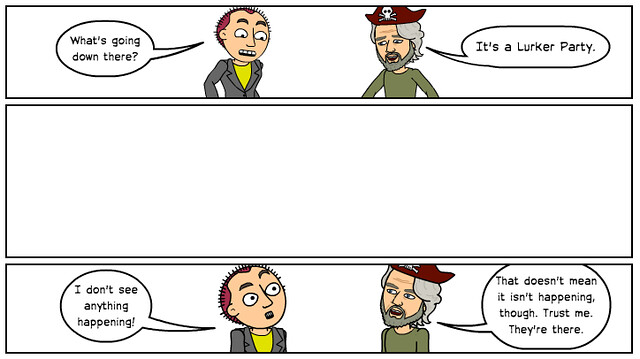
Lurking is good
Lurking as been discussed since the beginning of internet forums at the start of the millennium, when “lurking” was defined as “…reading discussions on a board, newsgroup,… social networking site, listening to people in …[an] interactive system, but rarely or never participating actively” [8]
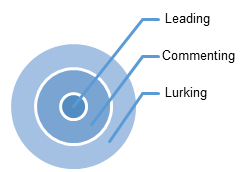
The leader to lurker framework: but what about other on- and off-line channels?
It has always been the case that the number in the audience is bigger than the number on stage. In fact, it is arguable that any community would not function for very long if everyone was trying to permanently take a leadership role.
“The first step to dealing with participation inequality is to recognize that it will always be with us” [7]
This partly goes back to the pyramid of participation (also known as the 1% rule). The relationship be content creators and lurkers is often depicted as a pyramid, but concentric circles can also be used as in the diagram above.
Quite a lot is known about lurking, actually…
The word “lurker” seems to have stuck as a term for this audience. However, lurking is a positive choice to pay attention to this community or this conversation [2,3]. There are levels of lurking too [9]:
- The most basic is the passive lurker, who signs up but does nothing – which might happen if the lurker realises they joined the wrong community.
-
The rest are in some way active lurking. The participant joins a group and:
- uses the information gained solely for their private use,
- or they may use and share the information with the community(ies) through other channels,
- or using it as a route to establishing personal contact.
This brings in the idea of multiple channels of communication (see also [1,5] ). One challenge is that the apparent non-response may because the channel of communication is invisible because it is offline, or in a closed online group [10] – the rise of closed groups in WhatsApp and Facebook means that this is increasingly the case.
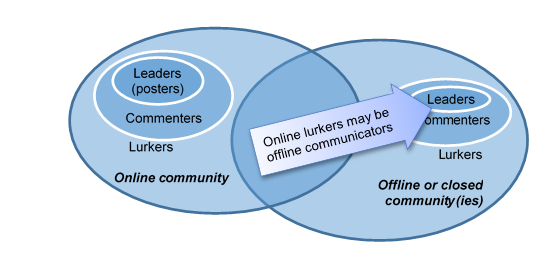
Lurkers on online public forums may be contributors or leaders elsewhere
Local communities are different
This is particularly relevant when looking at (geographical) community level engagement, where people are physically close to each other: you are as likely to bump into someone in the shop or see something on a noticeboard as are you are to respond online, or maybe even find out information online. (A lot of writing on online communities ignores the role of space).
From a community member’s point of view, there may also be the desire to only communicate to people who are known to be local. One of the contradictions in the use of internet platforms for local politics is that you are using a worldwide platform for a local conversation – with the risks of unknown and possibly unfriendly (and well resourced) outsiders joining in or pushing their agenda. This may be a motivation for community councillors to lurk in their own online community…
How do community leaders understand their lurkers?
This comes down to the community councillor’s perceptions & expectations of lurkers. We’ve looked at similar issues before – for instance how signing an e-petition can be seen as a transition from lurking to participation[2], and how useful the community of practice model is for explaining movements in and out of engagement with using the internet for political participation in community councils [3]: lurking has been seen as close to the idea of (legitimate) peripheral participation [6].
So: why not look at look at what the leaders think of their lurkers. Why do community councillors post information to a blog or website (or Facebook) even when they do not expect a (significant) response: what are their expectations of the lurkers and how (and where) the information they share will be used? Or is posting online seen as an activity (and social good) in its own right?
There are some indications that social media analytics provide one route to understanding the lurker (after all, it is another word for audience [4])– so in a way, social media platforms like Facebook are providing a tool for understanding lurkers, even if they can’t be communicated with.
Information literacy, information behaviour and information practice give oher perspectives. They allow us to focus on what is actually happening, explicitly avoiding psychological or organisational perspectives (though they do of course provide a context). We have gathered some data as part of the wider IL-DEM project which is looking how far information literacy can help community councillors do their job.
Acknowledgments
Thanks to Noella Edelmann for her notes and insights into the knowledge management and organisational learning approaches to lurking (including as the implications of the Takehashi and Nonnecke & Preece papers). Thanks as ever to Bruce Ryan for keeping the project moving. Some of this work was carried out in parallel with the IL-DEM project, which was funded by CILIP’s Information Literacy Group.
References
- Aichholzer, G., & Strauß, S. (2016). Collaborative Forms of Citizen (e-)Participation. In G. Aichholzer, H. Kubicek, & L. Torres (Eds.), Evaluating e-Participation (pp. 109–122). Cham: Springer International Publishing. http://doi.org/10.1007/978-3-319-25403-6
- Cruickshank, P., Edelmann, N., & Smith, C. F. (2010). Signing an e-petition as a transition from lurking to participation. In J. Chappellet, O. Glassey, M. Janssen, A. Macintosh, J. Scholl, E. Tambouris, & M. Wimmer (Eds.), Electronic Government and Electronic Participation (pp. 275–282). Linz, Austria: Trauner Verlag.
- Cruickshank, P., & Ryan, B. M. (2015). The Communities of Practice model for understanding digital engagement by hyperlocal elected representatives. In E. Tambouris, H. J. Scholl, M. Janssen, M. A. Wimmer, K. Tarabanis, M. Gascó, … Ø. Sæbø (Eds.), Electronic Government and Electronic Participation (pp. 11–18). IOS Press. http://doi.org/10.3233/978-1-61499-570-8-11
- Edelmann, N. (2012). Lurkers as Actors in Online Political Communication. In XXVI Convegno SISP Rome. Rome. Retrieved from http://www.sisp.it/files/papers/2012/noella-edelmann-1395.pdf
- Kubicek, H. (2016). What Difference Does the “E” Make? Comparing Communication Channels in Public Consultation and Collaboration Processes. In G. Aichholzer, H. Kubicek, & L. Torres (Eds.), Evaluating e-Participation (pp. 307–331). Cham: Springer International Publishing. http://doi.org/10.1007/978-3-319-25403-6_15
- Lave (2008) “Situated learning and changing practice,” in Community, economic creativity, and organization (pp. 283–296), Oxford: Oxford University Press
- Neilson, J. (2006) The 90-9-1 Rule for Participation Inequality in Social Media and Online Communities. Retrieved from https://www.nngroup.com/articles/participation-inequality/
- Nonnecke, B., & Preece, J. (2000). Lurker demographics: Counting the silent. In Proceedings of CHI 2000. Presented at the CHI 2000. The Hague, The Netherlands: ACM
- Takahashi, M., Fujimoto, M., & Yamasaki, N. (2007). Active Lurking: Enhancing the Value of In-house Online Communities Through the Related Practices Around the Online Communities (No. 4646–7). CCI Working paper. Cambridge MA. Retrieved from http://cci.mit.edu/publications/CCIwp2007-06.pdf
- Taylor-Smith, E., & Smith, C. (2016). Non-public eParticipation in Social Media Spaces. In A. Gruzd, J. Jacobson, P. Mai, E. Ruppert, & D. Murthy (Eds.), Proceedings of SMSociety ’16. ACM.
Posted in e-participation, Information behaviour, research, UK
Tagged community, Community Councils, Information literacy, lurkers, scotland, social media
5 Comments

 Spartakan